
Do Pigeons Just Spawn on the Streets? (The Reason You Never See Babies)

If you step outside in any major city, city pigeons are so common they are practically underfoot. It is estimated that around 400 million of them live in urban areas worldwide. But let me hit you with a deeply mind-boggling question: Have you ever actually seen a baby pigeons in real life?
Think about it. We easily spot tiny, fluffy baby sparrows, ducklings, and even stray kittens. Yet, these pigeons seem to operate like video game monsters spawning out of thin air—always appearing as full-sized adults.
Urban legends joke that pigeons are actually government surveillance drones, or that they hatch fully grown. But behind this funny mystery lies thousands of years of human architectural history and a brilliant cognitive illusion that tricks our very own brains.
High-Rise Penthouses: The Evolution of City Pigeons
The ancestors of our modern city pigeons are wild rock doves. The name itself gives it away. They naturally built nests in the crevices of steep, rugged coastal cliffs or rocky mountains where predators could never reach. They chose safety over convenience.
But then humans started building massive concrete skyscrapers. From a pigeon’s perspective, it was the jackpot: “Wait, no predators, food all over the ground, and perfect high-altitude cliffs?” Our cities became premium penthouses for them.
This is why they build their nests in spots completely hidden from human eyes—behind loud AC units or deep inside the massive supports of highway bridges. That deep-rooted instinct to hide on wild cliffs kicked right in. You might be thinking, “Even if they hide them well, shouldn’t we see the babies once they leave the nest?” In a normal world, yes. But pigeons have a biological cheat code.
Breaking Biology: Do Birds Really Produce ‘Milk’? (The Secret of Pigeon Milk)
This is where pigeons completely shatter basic biology textbooks. They use a special survival tool called pigeon milk. Yes, you heard that right—a bird that produces milk. It sounds like a prank, but it is entirely real.
Pigeons are incredibly unique among birds because they feed their young with a milk-like substance, much like mammals do. When a hormone called prolactin is released from the pituitary gland, both the male and female pigeons produce a thick, white liquid packed with fat and protein from a pouch in their throat called a crop. This is the ultimate protein shake, far richer than cow’s milk.
Bulking Up to Adult Size in Just 30 Days
What happens to a baby pigeons raised on this hyper-nutritious superfood? In just 30 days—literally a single month—their body mass pumps up to almost the exact same size as an adult pigeon.
They spend that vulnerable, tiny, and cute phase hiding away in the dark, unreachable corners of our concrete cliffs. By the time they finally decide to step out onto the sidewalk, they are already looking like full-grown adults.
At this point, you might think, “Come on, a 30-day-old teenager must look at least a little different from a seasoned veteran adult! My eyes aren’t broken!”
A Perfect Brain Glitch: You Are Already Seeing Baby Pigeons Every Day
Hold on just a second. We have covered the biology, but to truly understand this, we need to dive into cognitive psychology. The truth is, you are actually seeing baby pigeons every single day. Your brain is just filtering them out.
Schema Theory and Inattentional Blindness
The famous Swiss psychologist Jean Piaget introduced a concept called ‘Schema Theory.’ Our brains are actually quite lazy. Because analyzing every new thing is exhausting, the brain categorizes the world into fixed mental frameworks (schemas) to save energy.
Since childhood, picture books and cartoons have conditioned us with a powerful schema: “Baby birds are tiny, cute, fluffy, and go chirp-chirp.”
But what does a 30-day-old adolescent pigeon fresh out of the nest look like? It is already massive, covered in adult feathers, and looks nothing like a typical baby bird. So when you pass one on the street, your brain simply labels it as “just another regular pigeon” and filters it out. In psychology, missing something right in front of you because you do not expect to see it is called ‘inattentional blindness.’
🕵️♂️ 3 Pro-Tips to Spot a Freshly Independent Teenage Pigeon
So, how do we turn off this heavy brain filter and spot the fresh 10-something teenage pigeons on the street?

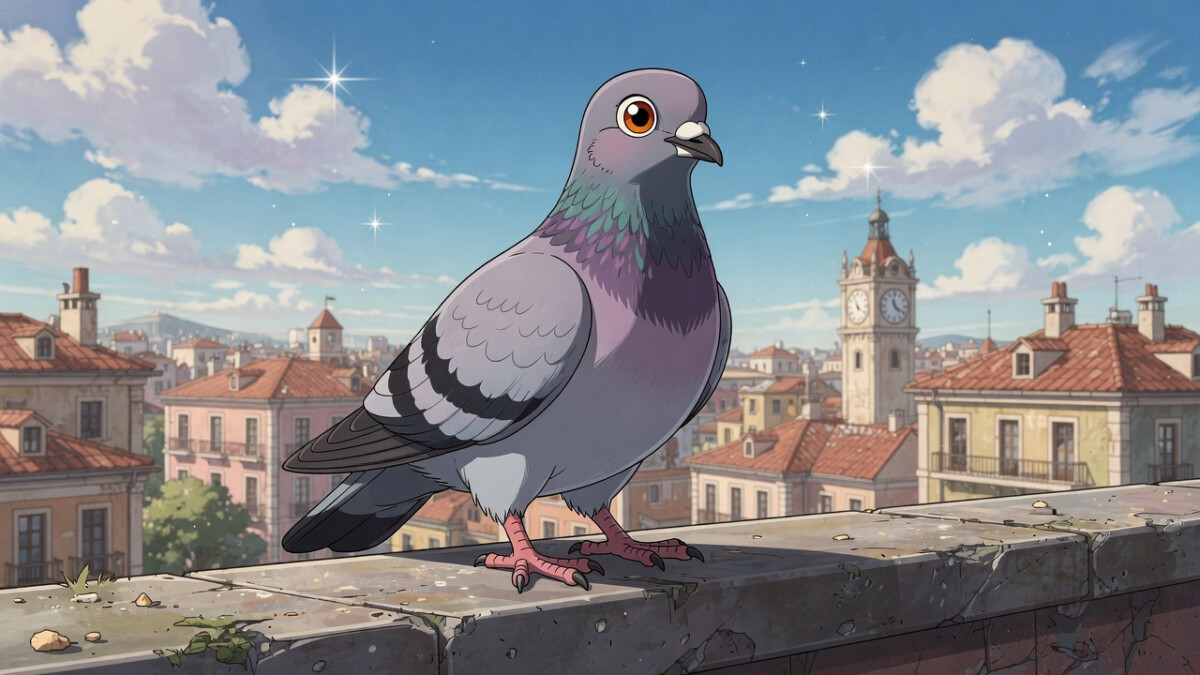
- Neck Feathers: Adult pigeons have a brilliant, shimmering green and purple iridescence on their necks. Young ones have dull, flat gray feathers with no shine.
- Eye Color: Adult pigeons have striking red or orange eyes. Younger pigeons lack full pigmentation, leaving them with pure, dark, button-like black eyes. They are actually quite adorable!
- The Cere (Nose Bridge): If you look above the beak, adults have a crusty white bump called a cere. On teenagers, this spot is still small, smooth, and soft pink.
The massive concrete jungle we built became the perfect fortress for pigeons, and our own lazy, efficiency-seeking brains turned their childhood invisible. It is living proof that seeing isn’t just about your eyes—it is about how your brain interprets the world.
Next time you are waiting at a crosswalk, take a close look at the pigeons around you. If you spot one with a dull neck and pure dark eyes, congratulations! You have just found a brand new baby pigeons navigating the big world.
Would you believe if the eggs you ate in Japan were fake eggs? – Moonists