

Urban Mystery: Where Do All the ‘Dead Pigeons’ Disappear to?
Everyone, today we’re going to dive into a truly bizarre urban mystery that we encounter daily but never really think about. Walk through the center of a bustling city like Seoul during lunch hour, and you’ll find pigeons so numerous you can practically step on them. They flock around, cooing “coo-coo,” and their boldness when people approach is sometimes astonishing. But have you ever stopped to think: “With this many pigeons, why have I never seen a dead one?“
While there are no official stats, the Ministry of Environment estimates there are at least 1 million pigeons nationwide, and over 100,000 in Seoul alone. Considering that the average lifespan of a pigeon in the wild is roughly three to five years, simple math dictates that dozens, even hundreds, of pigeons must die every single day in Seoul. But what about us? The probability of witnessing a pigeon carcass on the street feels significantly lower than winning a 5th-tier lottery prize. Most of you will probably say, “Huh, I’ve never seen one, have you?” Let’s crack this bizarre phenomenon open, using the key phrase why dead pigeons are rare to see.
1. Secrets from the Ancestral DNA: The Instincts of ‘Rock’ Pigeons
The first key to solving this mystery lies in the pigeon’s lineage. While we commonly call them “chicken-pigeons” in Korea (implying they are as common as chickens and sometimes as fat), the official name for urban pigeons is “domestic pigeon,” but their ancestors were known as “rock pigeons.” These were birds that built their nests in the crevices of steep coastal cliffs or caves to avoid predators. That wild instinct doesn’t disappear just because the environment has changed.
From this perspective, the modern city looks like a giant wild cliff face through a pigeon’s eyes. Gray concrete buildings are massive artificial cliffs, and the spaces behind apartment air conditioners or under bridge supports are very cozy caves. Pigeons, when sick or near the end of their lifespan, automatically find the deepest, highest, and most hidden spot, a sanctuary where human eyes will never reach, to end their journey.
For instance, the wide sidewalks or parks where we encounter them are just “dining halls” for pigeons. Who would want to spend their final moments in the middle of their dining hall? Their ancestral fear and their need for peace are driven by DNA, leading them to the city’s secret spots.
2. The City’s Invisible Cleanup Crew: Rats, Cats, and Crows’ Efficient Disposal
The second reason is a bit gruesome but is a very efficient cleanup system within the urban ecosystem. There is a massive, often unacknowledged, army of scavengers operating within the city. The representative players are rats, stray cats, and crows.
Rats, in particular, are the supreme cleanup commanders of the urban ecosystem. If a protein-and-fat-rich pigeon carcass is right there, for a rat, that day is a “party” day. If a pigeon dies in a secluded spot during the night, within a few hours, rats will rush in to finish the scene, leaving nothing but bones and feathers. Add stray cats to the mix, and the probability of a carcass remaining until the next morning becomes extremely slim.
Research by American ornithologists suggests that small bird carcasses in urban areas are removed by predators and insects in an average of less than 24 hours. This process is known forensically as “Taphonomy” (the science of fossilization). The warm, humid city environment and numerous microorganisms accelerate decomposition. Feathers are lightweight and get blown away, and remaining bones are eaten by other small animals needing calcium, leaving no trace.
3. World-Class ‘Spotless’ Urban Sanitation System
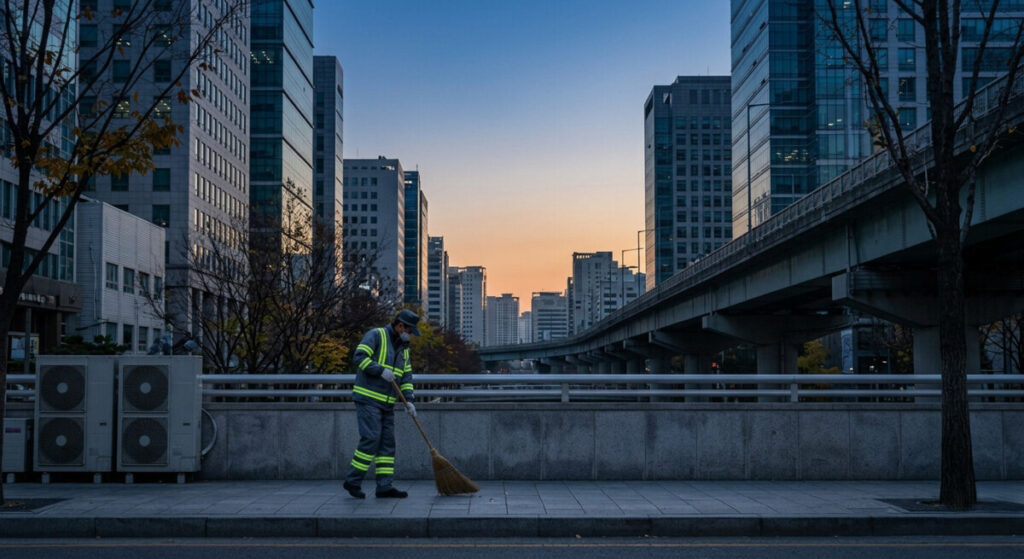
The third reason is a powerful factor, especially in countries like South Korea. It is the invisible hand: the urban sanitation system. Korea’s street sweepers boast some of the highest levels of diligence in the world. While we are asleep, during the pre-dawn or very early morning hours, they swiftly collect pigeons and any other carcasses along with the street trash.
For example, at 4 AM, long before we prepare for our commute, the streets have already been thoroughly cleaned. The pristine sidewalks we see on our way to work have this hidden labor behind them. This ensures there’s simply no time for carcasses to be left unattended for long.
4. An Illusion Created by Our Own Brain: The Trap of ‘Selective Perception’
Finally, I’ll add a psychological reason: our brain’s operating system, “selective perception.” Humans have evolved to react much more sensitively to moving objects.
The pigeons that flock around cooing and flapping to avoid us are intensely recognized by our brains, but the static gray lump stuck in a corner is often perceived as mere trash or a rock and is filtered out. It is a type of optical illusion created by our brains, which process only what we want to see and perceive.
Not Disappearing, but Being ‘Recycled’
Ultimately, the reason we don’t see dead pigeons on the street is a perfect collaboration between the pigeon’s instinct to hide, the rapid disposal by urban scavengers, the spotless urban cleanup system in Korea, and our own cognitive bias.
Pigeons do not simply vanish within the city; they are being “recycled” most rapidly and efficiently by the urban ecosystem scavengers. Perhaps this city that we walk daily is itself a massive cemetery for pigeons. This mystery helps us realize once again that the city is not just a block of concrete, but operates like a massive, organic entity.
Would you believe if the eggs you ate in Japan were fake eggs? – Moonists