
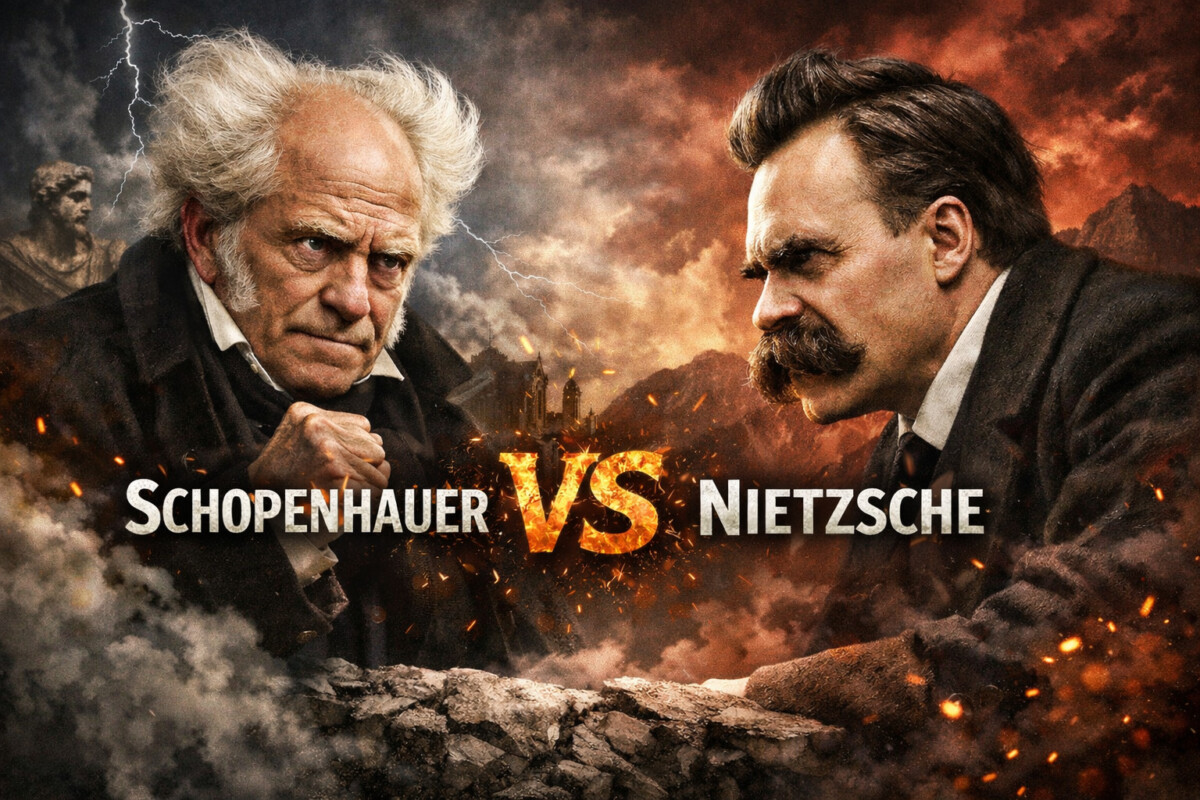
Schopenhauer’s Pessimism vs. Nietzsche’s Affirmation: Why the Student Rejected the Master
Arthur Schopenhauer is often the first philosopher we turn to when the inherent suffering of existence feels overwhelming. Recently, as I embarked on my ‘Newborn Project’—a significant turning point in my life—his somber reflections on human struggle became deeply personal.
During this transition, my husband and I spent many late nights discussing our future, asking, “How can we live a life that is not just successful, but genuinely fulfilling?” He once noted how fascinating it is that some find peace in letting go, while others find strength in the struggle. This sparked a shared curiosity to look deeper into the two thinkers who grappled with these exact questions: Schopenhauer and his disciple-turned-critic, Friedrich Nietzsche.
While Nietzsche initially hailed Schopenhauer as a lone truth-teller, he eventually became his most formidable critic. In my view, this personal crossroads is exactly where the paths of Schopenhauer and his disciple-turned-critic, Friedrich Nietzsche, diverge. Today, we delve into the core of this philosophical divorce. Drawing on scholarly insights and the ongoing debate over existential nihilism, we explore why Nietzsche viewed Schopenhauer’s “remedy” as a dangerous relapse—and what this means for us in 2026.
Schopenhauer’s Will and the Anatomy of Suffering
To understand the conflict, we must first understand Schopenhauer’s masterpiece, The World as Will and Representation. Schopenhauer argued that the fundamental essence of the universe is a blind, insatiable, and directionless force he called “The Will.”
In this view, individual human beings are merely temporary manifestations of this cosmic Will. Because the Will is essentially a giant “wanting machine,” it is never satisfied. This leads to a life defined by a cycle of desire and boredom. Schopenhauer’s solution? Detachment. He proposed that by recognizing the vanity of individual desires, one could achieve a state of “will-less” tranquility—a philosophical “antidote” to the pain of existence.
Nietzsche’s Critique: Moving Beyond the “Shadow of the Cross”
Nietzsche’s eventual break with Schopenhauer was sparked by a shocking realization: Schopenhauer was still a “hidden” theologian. Despite being a staunch atheist, Nietzsche argued that Schopenhauer’s philosophy inherited the same structural flaws as traditional Christianity.
- The Escape to the Beyond: Just as religions promise a “Heaven” or “Nirvana” to escape the pains of earth, Nietzsche saw Schopenhauer’s detachment as a way to flee from reality.
- The Sickly Spirit: Nietzsche classified any philosophy that treats suffering as a purely negative thing to be “removed” as a sign of a decaying or “decadent” spirit. To Nietzsche, seeking peace by extinguishing desire was equivalent to spiritual suicide.
For those interested in the broader history of these ideas, the Stanford Encyclopedia of Philosophy: Friedrich Nietzsche offers an academic deep dive into his transformation.
The Alchemy of Suffering: Nietzsche’s Creative Turn

The pivotal difference between these two giants lies in their valuation of suffering. For Schopenhauer, suffering was a bug in the system—a reason to reject life. For Nietzsche, suffering was a feature—a prerequisite for greatness.
Nietzsche famously posited that suffering has a creative function. He believed it:
- Strengthens the individual: Like muscles tearing to grow back stronger.
- Forces “Self-Overcoming”: It pushes humans to shed their old selves like a snake sheds its skin.
- Fuels Innovation: Without the friction of pain, the human spirit remains stagnant.
To Nietzsche, a person who does not suffer simply remains a “herd animal,” comfortably numb and devoid of depth. He argued that we should not seek to abolish suffering, but to find a “Why” that makes the “How” of suffering bearable.
Emotion vs. Pure Intellect: The Myth of Objectivity
Schopenhauer dreamed of reaching “pure perception”—a state where the intellect is free from the distortion of personal emotions. He believed that only by suppressing our feelings could we see the world as it truly is.
Nietzsche dismissed this as an illusion. He argued that “to eliminate the emotions is to castrate the intellect.” According to Nietzsche, we perceive the world through the “lens” of our passions and drives. If you remove the lens, you don’t see more clearly; you don’t see anything at all.
Even more cuttingly, Nietzsche analyzed Schopenhauer’s own philosophy not as an objective truth, but as a projection of Schopenhauer’s personal temperament. He suggested that Schopenhauer’s pessimism was driven by:
- Hatred of the body and the senses.
- Fear of happiness and beauty.
- A desire to escape the cycle of birth and death.
In Nietzsche’s eyes, Schopenhauer wasn’t a “pure” thinker; he was a man who hated life and built a magnificent philosophical cathedral to justify his resentment.
Choosing Your Perspective for 2026
Ultimately, the choice between Schopenhauer and Nietzsche is a choice of perspective.
Schopenhauer offers a path to peace in an chaotic world. He teaches us how to find a quiet center amidst the noise of consumerism and constant wanting. This “Stoic-adjacent” peace is highly valuable for mental health in a high-pressure society.
Nietzsche, however, offers a path to power. He challenges us to embrace the “tragic” beauty of life—to say “Yes” even to the parts that hurt. He reminds us that the goal of life is not happiness, but the creation of something higher than ourselves.
Which path resonates with you in 2026? Are you seeking the “antidote” to your pain, or the “strength” to use it as fuel? I found that by studying their conflict, I gained the tools to craft my own philosophy for this new chapter of my life. I’d love to hear which side you lean toward on my [Contact] page.
Recommended: