
Artificial Gold: Fact vs. Fiction—Is the “Golden Era” of Investing Over?
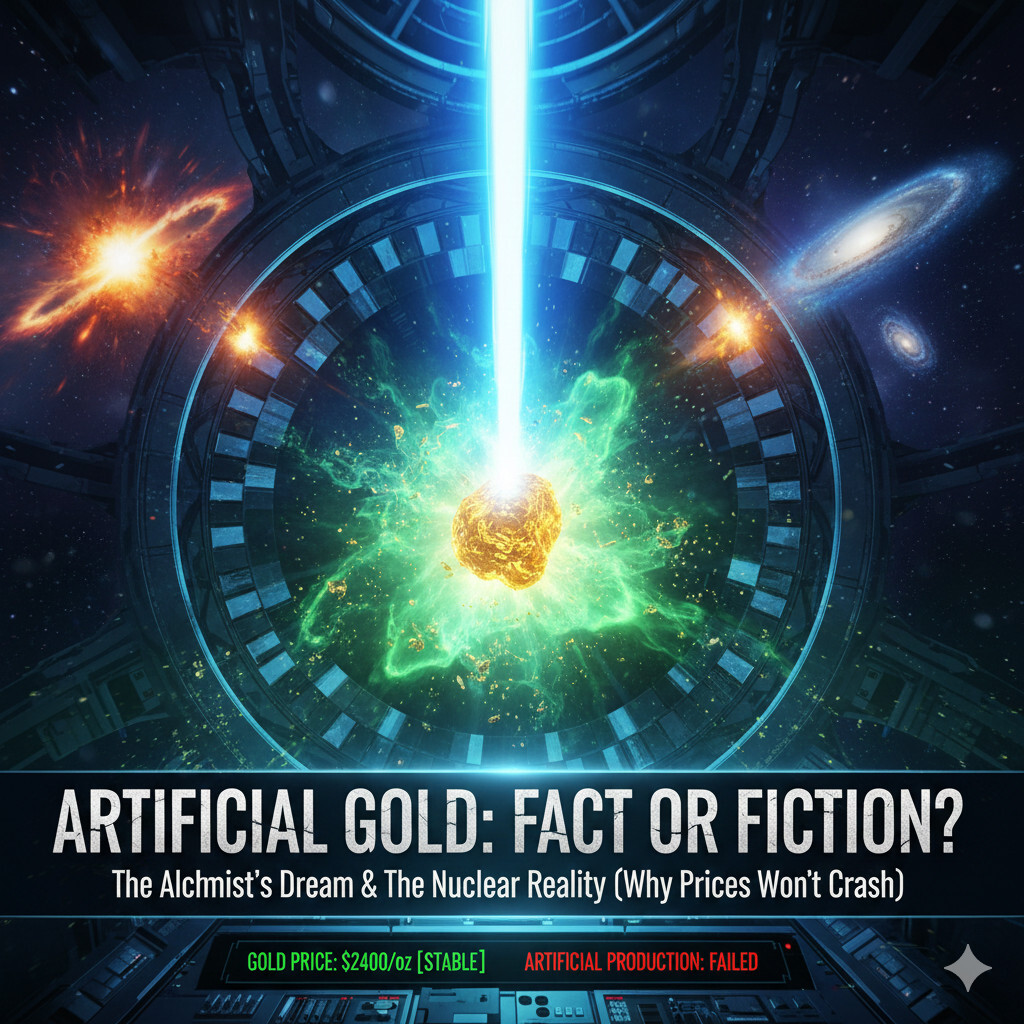
Throughout the long tapestry of human history, gold has been far more than just a shiny metal; it has served as the ultimate anchor of value. From the Spanish conquistadors’ frantic, blood-soaked search for El Dorado to modern-day investors flocking to bullion during seasons of rampant inflation, gold’s allure remains timeless. However, a provocative question has recently resurfaced in both scientific and financial circles: “If we have finally unlocked the secret to creating artificial gold in a lab, is the gold price crash theory about to become a reality?”
In my exploration of this fascinating intersection between science and finance, I’ve found that the truth is far more complex than the headlines suggest. Today, we will dive deep into the hard science of modern alchemy, exploring why your physical gold bars are likely safer than almost any other asset in your portfolio.
Newton’s Secret Passion: The Legacy of a Closet Alchemist
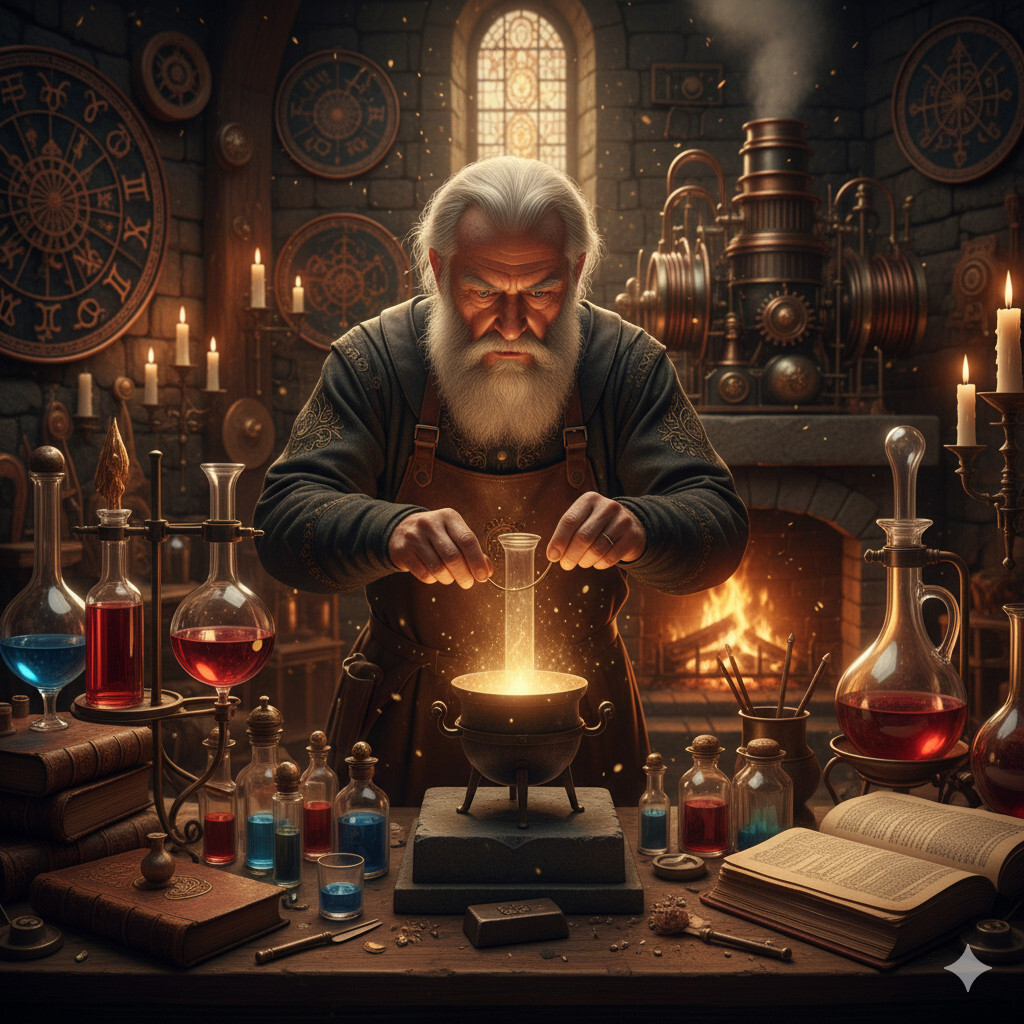
While the world remembers Sir Isaac Newton for his groundbreaking laws of motion and gravity, he spent a massive portion of his private life as a “closet alchemist.” When his personal papers were auctioned long after his death, they revealed over a million words dedicated to the study of transmutation—the art of changing base metals into gold.
Newton and his predecessors failed for a very simple, fundamental reason: they were focused on chemistry. They spent centuries mixing, heating, and distilling various substances to change their outward properties. But gold is an element, defined by a specific, immutable number of protons in its nucleus—exactly 79. To turn something else into gold, you don’t need a better chemical reaction or a more potent acid; you need the high-energy world of nuclear physics.
Born in the Stars: The Incredible Cosmic Origins of Gold
To understand why gold is so difficult to manufacture, you first have to understand its “birth certificate.” Gold isn’t native to the Earth’s natural geological cycles; it is a cosmic immigrant.
The first theory of its creation involves the Supernova Forge. When a massive star reaches the end of its life and explodes, the sheer force is enough to fuse lighter elements into heavier ones. However, recent astrophysical models suggest that supernovas alone don’t account for the sheer volume of gold we find in our universe.
The more widely accepted theory today is the Kilonova—the collision of neutron stars. Imagine two objects so dense that a single teaspoon of their material weighs a billion tons, colliding at unimaginable speeds. In 2017, the LIGO gravitational wave observatory confirmed that such a collision literally showers the universe with gold. A single kilonova can produce gold equivalent to hundreds of times the mass of the Earth. This is why gold is rare; it requires an event of universal proportions to exist.
The Modern Philosopher’s Stone: How a Particle Accelerator Works
We have officially moved from the myths of the Middle Ages to the reality of the 21st century. We can, in fact, make gold today using a particle accelerator gold production method.
The math is surprisingly basic: Gold is element 79. Mercury is 80, and Bismuth is 83. If you can knock one proton off mercury or four off bismuth, you have gold. In 1980, Nobel laureate Glenn Seaborg successfully used a particle accelerator to bombard bismuth with carbon and neon nuclei at near-light speeds. He succeeded in creating gold atoms. It was a landmark moment—the first time in history that a base metal was turned into a precious one by human hands.
Why the Market Won’t Crash: The 3 Fatal Flaws of Lab-Grown Gold
If we have the technology to play God with elements, why isn’t gold trading at the price of copper? Why hasn’t the gold price crash theory wiped out fortunes? There are three massive, insurmountable barriers that make lab-grown gold a financial and practical nightmare.
I. The Astronomical Cost of Production Running a particle accelerator requires a staggering amount of energy and global-scale infrastructure. Seaborg’s gold was microscopic—just a few atoms that couldn’t even be seen with the naked eye. At today’s energy rates, producing just one ounce of gold in a lab would cost quadrillions of dollars. Digging a mile-deep hole in the ground is still billions of times cheaper than firing up a collider.
II. The Invisible Threat of Radioactivity When you force protons in or out of a nucleus, the resulting atom is often unstable. This is what we call a radioactive isotope. Artificial gold created through transmutation is often “hot”—it emits dangerous radiation and eventually decays back into other substances like mercury or lead. Wearing an “artificial gold” wedding ring could lead to severe radiation burns, making it useless for the luxury or jewelry markets.
III. The Impossible Sorting Task While a few stable, safe gold atoms might be created during the bombardment, they are mixed with trillions of radioactive ones. Separating them is like trying to find one specific grain of sand on a massive beach using only a pair of tweezers. You would need a mass spectrometer to weigh and sort every single atom, a task that is physically and economically impossible on a commercial scale.
The Future of Gold as an Asset in a Volatile Market
Investors often mistakenly compare gold to diamonds. Lab-grown diamonds have disrupted the jewelry market because they are chemically identical to mined ones and can be “grown” in a furnace. However, gold is a primordial element, not a molecular structure. It cannot be grown; it must be forged in nuclear fire.
Even with the recent short-term volatility in prices, the future of gold as an asset remains incredibly secure. While fiat currencies can be printed and digital assets can be forked, the total amount of gold on Earth is fixed by the laws of physics. For those tracking market shifts, historical data from sources like the U.S. Federal Reserve Economic Data (FRED) consistently shows that gold maintains its purchasing power over centuries, regardless of technological shifts.
The Real Treasure is Knowledge
In the end, our quest to “make” gold taught us that the magic of the universe is much more expensive than we ever imagined. Modern alchemy didn’t give us cheap gold, but it did give us nuclear medicine, quantum mechanics, and a deeper understanding of the stars.
If you are a gold investor, you can rest easy. Your gold was forged in the heart of a dying star billions of years ago, and no lab on Earth is going to replace that cosmic rarity anytime soon. Gold remains the king of assets, not because of its color, but because of its absolute, physical scarcity that even the most advanced particle accelerators cannot overcome.
For those curious about the actual scientific process of atomic transmutation and the history of modern alchemy, you can find incredibly detailed explanations through resources like Scientific American
or National Geographic, which offer deep dives into how humanity finally “solved” the puzzle of making gold—and why it remains economically impossible.
If you are interested in investing in gold, I recommend reading ‘2026 How the U.S. is Neutralizing China’s Gold and Cash Reserves‘ first.