

2026 Global Economy Outlook: Where Robots Work and Money Evolves

The year 2026 marks a historic turning point for the global financial landscape. We are no longer just “preparing” for a digital future; we are living in it. The traditional correlation between human labor and economic growth is decoupling as artificial intelligence and robotics take center stage. Based on the latest insights into the 2026 Global Economy, we are witnessing a paradigm shift where productivity is driven by silicon and code rather than just bone and muscle.
In this article, we will explore the deep structural changes occurring in the workforce, the fundamental reimagining of currency, and how you can position yourself to thrive in this new era.
The Rise of the Robot Automation Economy
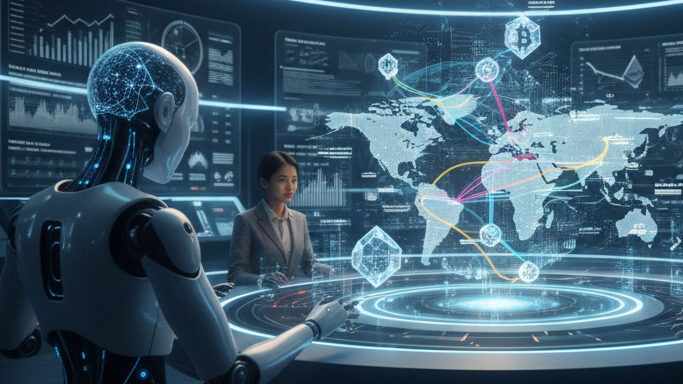
In the past, industrial robots were confined to cages on factory floors, performing repetitive tasks with zero autonomy. However, the Robot Automation Economy of 2026 is powered by “embodied AI”—robots that can see, learn, and adapt to complex environments.
This transformation isn’t just happening in manufacturing. From autonomous delivery bots to AI-driven diagnostic tools in healthcare, automation is penetrating the service sector at an unprecedented rate. While this leads to a massive surge in corporate efficiency and a reduction in production costs, it also necessitates a radical “redefinition of work.” Human roles are shifting away from manual execution toward high-level oversight, creative strategy, and robot-human collaboration.
The Future of Money: Beyond Physical Cash
As we move deeper into the decade, the concept of “money” is shedding its physical skin. The Future of Money is increasingly defined by Central Bank Digital Currencies (CBDCs). Unlike the physical cash or even the digital banking we used in the past, CBDCs allow for programmable, traceable, and instantaneous transactions.
The implementation of CBDCs aims to eliminate the friction in cross-border payments. Imagine a world where international wire transfers happen in milliseconds with near-zero fees. While this transparency helps combat tax evasion and streamlines government stimulus, it also opens up critical debates regarding financial privacy and the changing role of traditional commercial banks. We are moving toward a world where the “velocity of money” reaches its theoretical maximum.
Global Economic Insight: For more detailed statistics on global monetary shifts and inflation data, you can visit theInternational Monetary Fund (IMF) Official Data Portal.
Digital Asset Outlook: From Speculation to Utility
With the decline of traditional fiat dominance, the Digital Asset Outlook has never been more significant. Assets like Bitcoin and Ethereum have transitioned from speculative vehicles to “programmable utility.”
Through Smart Contracts, the 2026 economy is automating trust. Real estate transactions, insurance payouts, and royalty distributions are now being handled by decentralized protocols that don’t require expensive intermediaries. As institutional adoption reaches a fever pitch, digital assets are being integrated into standard retirement portfolios, serving as a hedge against the volatility of traditional fiat systems and a bet on the underlying technology of the new internet (Web3).
AI Economic Transformation: Data as the New Oil
The AI Economic Transformation is fundamentally tied to two resources: Data and Energy. In 2026, data is no longer just “information”—it is the most valuable commodity on Earth. Robots and AI models require massive amounts of high-quality data to function, making data sovereignty a major geopolitical issue.
Furthermore, the surge in AI processing power has shifted the global power balance toward nations that can provide cheap, sustainable energy. We are seeing a “Green Energy Renaissance” where renewable infrastructure is being built specifically to power the massive data centers that run the global economy. This shift means that future wealth will be concentrated in regions that master both the algorithm and the energy required to run it.
Survival Strategies in the New Era
How does an individual or a small business survive the 2026 Global Economy? It requires a shift in mindset from “worker” to “orchestrator.”
- Digital Literacy: Understanding how to prompt, manage, and audit AI tools is now a basic requirement, similar to literacy in the 20th century.
- Emphasizing Human Soft Skills: While robots excel at logic and repetition, they still struggle with empathy, complex ethics, and high-level creative synthesis. These “human” traits are becoming the highest-paid skills in the market.
- Diversified Portfolio: Keeping all your wealth in a single currency or a single type of asset is riskier than ever. Exposure to the tech sector, renewable energy, and digital assets is essential for long-term resilience.
Embracing the Great Transition
The 2026 Global Economy presents both a daunting challenge and an incredible opportunity. The “end of money” as we knew it isn’t a crisis; it’s an evolution toward a more efficient, transparent, and automated world. By understanding the intersection of the Robot Automation Economy and the Future of Money, you can move from a position of uncertainty to one of leadership. The future belongs to those who can bridge the gap between human intuition and machine efficiency.