
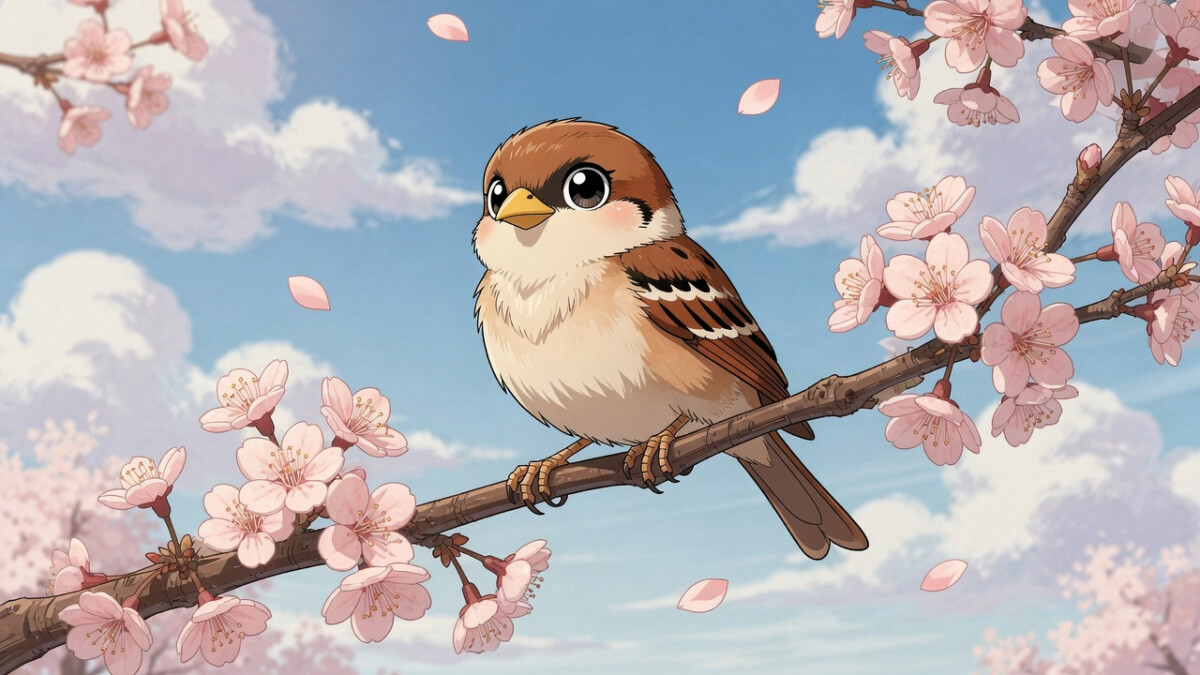
The Secret Life of Sparrows: How Urban Sparrows Evolved to Exploit Humans

A common misconception arose after our recent discussion on pigeon milk: “Aren’t baby pigeons just sparrows? I’ve seen them together!” This misunderstanding comes from the fact that we rarely see pigeon chicks, which stay in the nest until nearly full-grown, while sparrows are naturally small. Though always by our side and seemingly familiar, we rarely truly perceive them. Today, we’ll clear up that confusion and dive deep into the truly secret life of sparrows—a life far more sophisticated than that of pigeons. You’ll be stunned to learn how these seemingly cute birds are, in fact, incredibly cunning urban wildlife survival specialists with high sparrow intelligence.
1. A Planned Stalking 100 Centuries in the Making: Destined in Their DNA
Have you ever stopped to wonder why sparrows never leave human settlements? If you thought it was simply because we have a lot of crumbs, you’ve underestimated sparrow intelligence. Their adaptation was a calculated, biological choice for survival, etched deeply into their DNA.
In 2018, a research team from the Norwegian University of Science and Technology (NTNU) published a shocking study in the prestigious scientific journal ‘Science’. The team conducted a precise genetic analysis of house sparrows. They discovered that sparrows rapidly increased their gene pool for starch-digesting enzymes roughly 10,000 years ago—exactly aligning with when humans began agricultural farming. As humans started cultivating and consuming rice and wheat, sparrows altered their own genetic blueprint to make this new food source their primary diet.
This is an extremely rare case in avian evolution. Sparrows essentially became humanity’s agricultural partners, evolving with us. This goes far beyond just stealing food; it’s a strategy of, “I will adapt my very biology to exploit what you eat,” which is, frankly, a bit chilling. The human-sparrow relationship isn’t just one of pest and host; it’s a 10,000-year-old genetic bond.
2. City Birds vs. Country Birds: Do Sparrows Use ‘Dialects’?
It gets even more fascinating. Sparrows, much like humans, have ‘dialects’ based on where they live. This isn’t just regional flavor; it’s a desperate adaptational change.
Ornithologists conducted a detailed analysis of the songs of urban sparrows versus rural ones. The results were dramatic. The calls of city sparrows had significantly higher frequencies and a much faster rhythm. Why? Cities are filled with low-frequency background noise—car engines, construction, and machinery. Singing low and slow, as their country cousins do, would mean their love songs would be completely drowned out. To attract a mate, they had to evolve a high-pitched call that could cut through the urban chaos.
Because of this, scientists sometimes jokingly suggest that a sparrow from the busy streets of downtown New York might fail to communicate with one from the rural Midwest, leading to a breakdown in mating. This ability to alter their fundamental communication style to match their environment is a hallmark of the urban sparrow’s survival strategy.
3. Alcohol and Nicotine? The Intelligence of Exploiting Human Habits
Do you enjoy a social drink? Interestingly, some urban sparrows have unintentionally become ‘alcoholics.’
In many cities, trees like the Rowan or ornamental berries drop fruit that, when warmed by the sun, ferments and creates natural alcohol. The sparrows have developed a knack for finding these drunken treats. A tipsy sparrow has a noticeably lower flight altitude and might even be seen wobbling on a power line before, yes, falling off. Even more intriguingly, much like humans, sparrows get bolder when intoxicated. There are frequent reports of drunken sparrows, lacking all fear, chirping provocatively at their arch-nemesis—cats—only to meet a tragic, fuzzy end.
Their secret life gets even darker. Recent studies have found that sparrows are now using human-discarded cigarette butts to build their nests. This isn’t just casual litter collection. The sparrows have instinctively understood that the nicotine left in the butts acts as a natural insecticide, repelling parasites like mites and lice that would harm their chicks.
The fact that these tiny creatures utilize both alcohol and nicotine to their advantage is stunning. It shows a profound level of sparrow intelligence, where they have learned to counter-exploit human-made pollution into a smart pest control system for their young.
4. The Sparrows That Changed History: Mao Zedong and the Great Leap Forward
There is a defining historical moment that shows just how significant sparrows are, proving they are far more than just cute, chirping birds. They are an integral part of the ecosystem, and trying to eliminate them can have catastrophic consequences for humans.
During China’s Great Leap Forward campaign, Mao Zedong, seeing sparrows eat grain that could feed the people, declared, “that bird is bad,” and labeled sparrows a public enemy. This sparked the ‘Four Pests Campaign,’ or ‘Great Sparrow Campaign.’ Over a year, an estimated 200 million sparrows were hunted and killed, bringing them to the brink of extinction.
The result? With the sparrows gone, the populations of locusts, weevils, and other pests they normally ate exploded. In their attempt to protect the grain, the people had destroyed its primary natural defender. The subsequent agricultural devastation led to a widespread famine. It is estimated that in just three years, as many as 42 million people died of starvation—a population nearly equal to that of an entire large nation.
This tragic history, where humans tried and failed to eliminate sparrows, is a humbling reminder of their vital role. They know us, and know how to utilize us, better than we know them. Perhaps they are watching us even now, thinking:
“Hmm, looks like their diet is shifting. Time to update my DNA again.”
Re-evaluating the Sparrow, the True Ruler of Urban Survival
It’s time to stop seeing sparrows as merely cute, chirping creatures. They are high-level urban wildlife survival specialists that have modified their DNA to match our agricultural history, evolved their language to cut through our noise, and learned to counter-exploit our nicotine and alcohol habits. They are our longest-standing, and perhaps wisest, evolutionary companions. The next time you see a sparrow, take a moment to respect the 10,000 years of survival wisdom packed into that tiny frame.
US Tipping Culture Vol. 2: The Truth Behind Tipflation and Survival Strategies – Moonists