
The Death of the Dollar and the Rise of a New Hegemony: Why Gold and Bitcoin Are Parting Ways
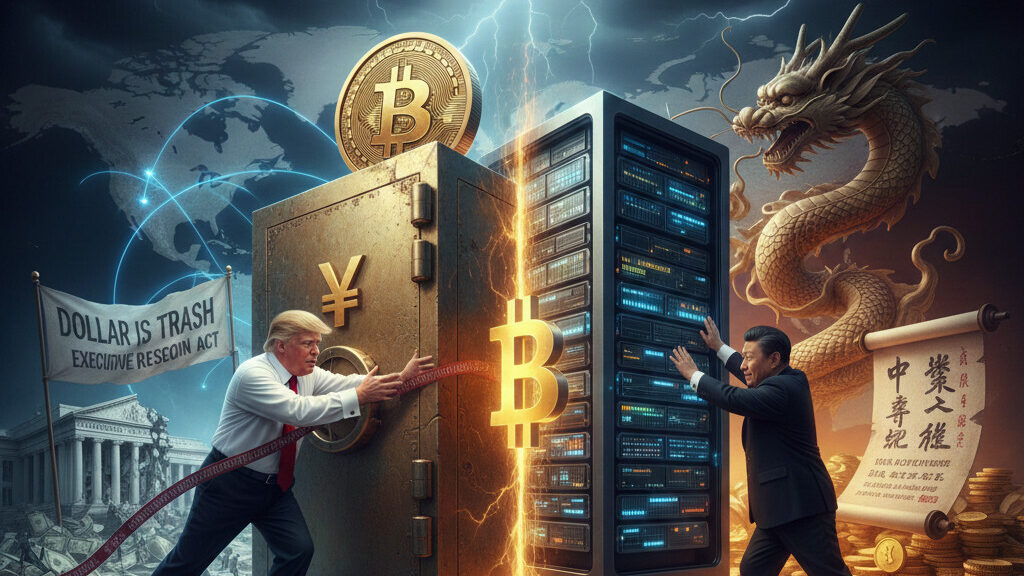
The global financial landscape is currently undergoing a seismic shift that feels like a once-in-a-century event. For decades, the US dollar has reigned supreme as the world’s undisputed reserve currency, but as the American debt crisis deepens, a new narrative is emerging—one that suggests the “Greenback” might be losing its luster. In my observation of the current market, especially with the return of the “America First” economic agenda, the conversation has moved beyond simple market fluctuations to a fundamental re-evaluation of money itself. If you’ve heard the provocative claim that “the dollar is becoming trash,” it’s time to analyze why Gold and Bitcoin—once grouped together—are now charting very different strategic courses for the future.
The $38 Trillion Shadow: Why the Dollar’s Value is Melting
Currently, the US national debt has surged past the $38 trillion mark. To put that into perspective, it’s a figure that significantly exceeds the total annual economic output of the entire United States. Historically, when a superpower accumulates debt it cannot possibly repay through traditional means, the outcome is predictable: currency devaluation. The most realistic way for the US government to handle this burden isn’t through radical tax hikes—which are politically suicidal—하지만 by printing more money.
By increasing the supply of dollars, the government triggers inflation. While this makes life more expensive for the average consumer, it effectively shrinks the “real” value of the debt the government owes. In this scenario, anyone holding cash or dollar-denominated assets is essentially watching their purchasing power melt away. Unlike the old days of the Gold Standard, where every bill was “allocated” to a specific vault number, today’s dollar is an “unallocated” fiat currency backed by nothing but “full faith and credit.” That faith is now being tested like never before.
China’s Golden Trap vs. America’s Digital Shield
China has been the most meticulous architect of a “De-Dollarized” future. After witnessing how quickly Russian assets were frozen via the SWIFT system, Beijing accelerated its push to settle oil trades in Yuan. However, the Yuan faces its own credibility issues. To bridge this gap, China introduced a brilliant workaround: the Shanghai Gold Exchange. By offering real-time physical gold conversion for Yuan-denominated oil trades, China is essentially building a “Golden Standard” for the 21st century.
The American response, spearheaded by the Trump administration’s vision, is not to fight for the physical gold China has already spent decades hoarding. Instead, the U.S. is looking to change the rules of the game entirely. This is the birth of the “Digital Gold Standard.” By designating Bitcoin as a strategic national reserve asset, the U.S. plans to sell off portions of its gold reserves to acquire over a million Bitcoins. If successful, this “Trump Shock” would mirror the 1971 Nixon Shock. Back then, Nixon decoupled the dollar from gold; now, Trump aims to re-couple the dollar with Bitcoin to maintain global dominance.
From Petro-Dollars to Electro-Bits: The Energy Hegemony

The dollar’s dominance was historically cemented by the Petro-dollar system. Because the world needed oil, and oil was priced in dollars, everyone had to hold Greenbacks. But the core engine of the future is shifting from fossil fuels to electricity. In an era dominated by AI, massive data centers, and humanoid robotics, electricity is the ultimate raw material. Bitcoin, at its core, is “stored energy”—a digital asset created by the massive consumption of electrical power.
The vision for a “Bitcoin Strategic Reserve” is to transition from a Petro-dollar to an “Electro-bit” system. By dominating the Bitcoin supply, the U.S. intends to set the global benchmark for the value of electricity. This isn’t just a financial play; it’s a national security strategy designed to extend American hegemony for another century. In this new world, Bitcoin isn’t just “magic internet money”; it’s digital territory.
The Survival Strategy: Protecting Your Purchasing Power
For the average investor in the West, we are moving from a “Financial Economy” back into a “Hard Asset Economy.” Gold prices continue to face upward pressure because it remains the ultimate “fear index” against US debt. However, once the U.S. government officially begins its Bitcoin acquisition, we may see a massive rotation of capital. The “purchasing power” that has lived in gold for 5,000 years may begin to flow into the digital scarcity of Bitcoin.
While gold will likely always remain the “King of Metals,” it is a passive asset. Bitcoin, on the other hand, is an active network. The U.S. strategy involves using Bitcoin to suppress the influence of China’s gold hoard while establishing a new digital order. Therefore, a modern portfolio shouldn’t just look at price volatility; it must account for the geopolitical war and the transformation of the global energy system.
In this era of Hard Assets, value will be found in things that are real, scarce, and essential. This includes not just Bitcoin and Gold, but also critical commodities like uranium, copper, and lithium—the building blocks of the electric future. To stay ahead of these policy shifts, it is crucial to monitor official government data. You can track the actual debt issuance and fiscal reports at the U.S. Department of the Treasury to see just how fast the currency is being devalued. Furthermore, keeping an eye on the U.S. Securities and Exchange Commission (SEC) press releases will provide clues on how quickly digital assets are being integrated into the traditional financial system.
We are standing at a historic crossroads. The collision between China’s “Physical Gold Strategy” and America’s “Digital Gold Strategy” will define the economic winners and losers of the next century. Understanding that the dollar’s dominance is being reshaped to preserve global influence is the first step in protecting your financial future. True wealth preservation now requires a sophisticated understanding of both tangible and digital assets. How are you preparing your portfolio for this transition? If you have questions about diversifying into these new asset classes, feel free to reach out to me via the ‘Contact’ page.
Read More on Economy & Trends: