
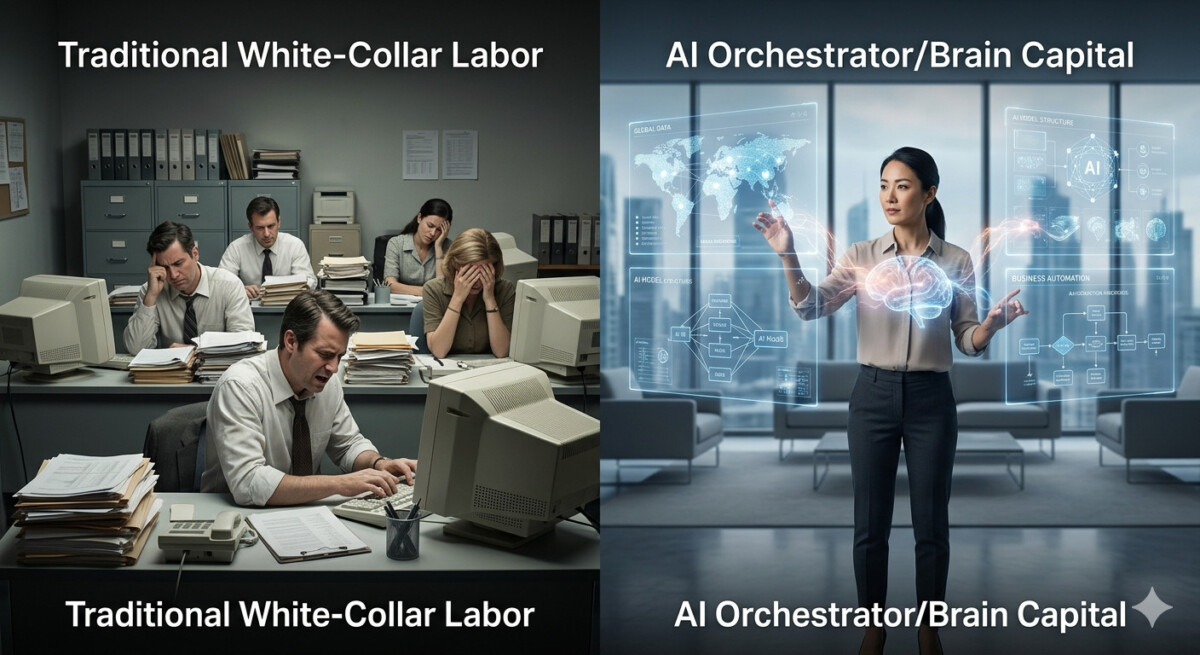
2026 AI Job Displacement? : The Tragic Layoff of Senior Manager Smith
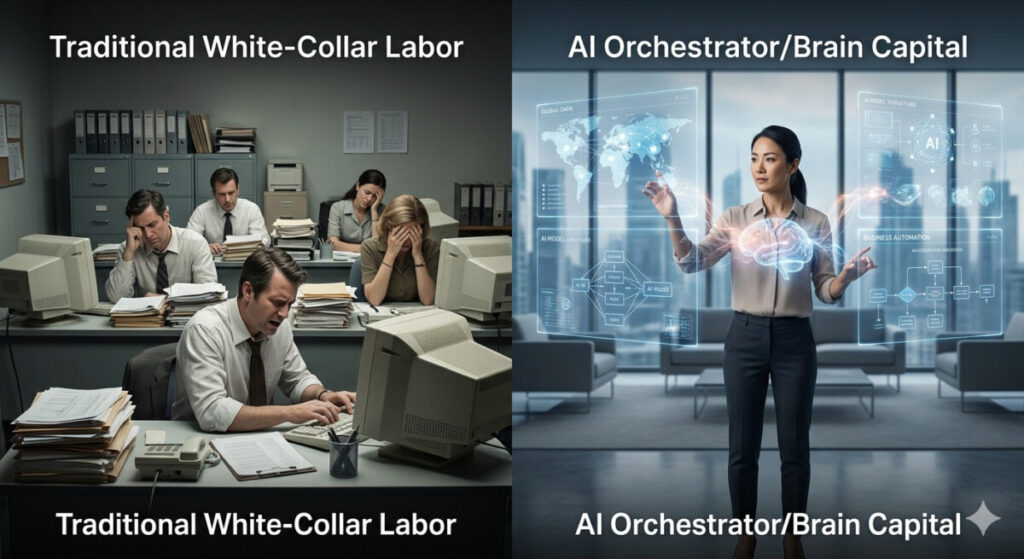
AI Job Displacement? In the heart of Manhattan’s Financial District, a senior strategy manager earning a comfortable $180,000 salary packed his desk into a cardboard box this morning. To the casual observer, it looked like a personal professional tragedy. Yet, as soon as the opening bell rang on Wall Street, his company’s stock price surged by 15%, hitting an all-time historical high. Did the company lose its mind? Or did “Senior Manager Smith” secretly sabotage the firm?
Neither. This is the sound of capitalism operating with more ruthless efficiency than ever before. It is the cold, hard evidence that the system is working exactly as intended. While you were spending a decade grinding for that Ivy League degree and stacking your resume with prestigious certifications, massive data centers in Silicon Valley were learning to swallow those credentials for the price of a few cents’ worth of electricity.
If you read this article to the end, you will hold the “cheat sheet” for the 2026 economy. You will discover whether your livelihood is destined to evaporate by next year or if you can exploit the loopholes in this brutal system to 10x—or even 100x—your personal market value. The choice isn’t about working harder; it’s about shifting your position in the hierarchy of intelligence.
Chapter 1. The Death of the “Time-for-Money” Fallacy
From the moment we enter the school system, we are gaslit into believing a fundamental lie: that “hard work and time investment equal wealth.” This is the Labor Theory of Value, and in the age of Generative AI, it is officially obsolete. But where did this “Time = Money” formula even come from?
To find the answer, we have to look back at the 19th-century Industrial Revolution. As assembly lines began to churn, factory owners didn’t need creative geniuses. They needed “human parts”—reliable, obedient workers who would show up at 9:00 AM, perform repetitive tasks without error, and leave at 5:00 PM.
This is why our modern education system was built. It was a factory for producing office-ready cogs. We were ranked based on who could memorize the most “correct” answers the fastest. We took out six-figure student loans and spent our 20s chasing SAT scores, MBAs, and CPA licenses because we were promised that the volume of knowledge in our heads was our ticket to the middle class.
Today, that rulebook has been shredded. The “answers” you spent ten years memorizing can be spat out by an AI Agent in 0.1 seconds, with better grammar and for virtually zero cost. Knowledge used to be expensive because it was scarce. Now, the marginal cost of knowledge is trending toward zero. If your income is based on knowing the “right answer,” your professional death certificate has already been signed.
Chapter 2. The Great White-Collar Massacre: Why “Elite” Jobs are Disappearing
There is a terrifying pattern emerging in the 2025-2026 employment data from Wall Street and Silicon Valley. In the past, we assumed that automation would first replace blue-collar labor—factory workers and truck drivers. We were dead wrong.
In the U.S. today, skilled trades like plumbers, HVAC technicians, and electricians are becoming more valuable than ever. These roles require physical dexterity in unpredictable environments—something robots still struggle with. The real carnage is happening under the air-conditioned vents of corporate headquarters.
The top 80th percentile of earners—the “intellectual elite”—are now the primary targets of AI displacement. We are talking about roles in administration, strategic planning, marketing, translation, and even entry-level legal counsel. Why is capital coming for the “smart” people first? Because the ROI (Return on Investment) of replacing an expensive human brain with a cheap digital one is simply too high to ignore.
- Example 1: The Marketing Campaign
- The Old Way (2022): To launch a global campaign, you needed a data team to crunch numbers for a week, copywriters to draft slogans, and a design team to create visuals. The monthly overhead was hundreds of thousands of dollars.
- The 2026 Way: You give an AI Agent a goal and a budget. It scrapes real-time search trends, generates 50 variations of A/B test copy, synthesizes high-conversion images, and buys the ad space in under 10 minutes. Total cost? A few dollars in API tokens.
If you are a CEO, do you keep a team of 30 people who want “work-life balance,” raises, and better office snacks? Or do you subscribe to a digital intelligence that works 24/7 without a single complaint? Capitalism always flows toward efficiency. If your job involves sitting in front of a monitor, summarizing information, and sending it to a boss, your countdown has already begun.
Chapter 3. The $500 Billion “Money Machine”: How America is Consuming Global Wealth
Where is all the money from these “saved” salaries going? This is where we see the most significant shift in global power in history.
Tech titans like Microsoft, Google, Meta, and Amazon are currently in a spending frenzy. In 2026 alone, their combined Capital Expenditure (CAPEX) on AI infrastructure and proprietary chips is expected to exceed $500 billion to $700 billion. That is more than the entire GDP of many developed nations.
They aren’t spending this money out of the goodness of their hearts. This is an aggressive hunt for the world’s labor costs. By owning the “intelligence,” these American companies are capturing the productivity gains of every other industry. When a law firm in London or a design agency in Seoul replaces a human with an AI tool, the “salary” that used to stay in the local economy now flows directly to a server farm in Iowa or Virginia.
This is the mechanism behind why a company’s stock hits a record high when it announces layoffs. The market is cheering for the transition from “human-heavy expense” to “software-heavy margin.”
Chapter 4. AI Revolution : Spelled-Out Resumes vs. “Brain Capital”
Is there any hope? Yes, but only if you climb the new “Class Ladder.” As traditional credentials turn into “worthless paper,” a new class of hyper-valued individuals is emerging. The World Economic Forum’s 2026 Jobs Report identifies their core asset as “Brain Capital.”
In the old world, we valued “Hard Skills”—reconciling financial statements, writing Python code, or translating documents. AI now does these things better than any human. The new world values “Instinctual Intelligence.”
- Example 2: The AI Doctor vs. The Human Healer
- Diagnosis (Hard Skill): An AI can identify a tumor on an MRI with 99.9% accuracy, outperforming a team of 100 radiologists. In the realm of “finding the answer,” the human is obsolete.
- The Context (Instinctual Intelligence): What AI cannot do is look a sobbing patient in the eye, navigate the complex family dynamics of a patient refusing surgery, and use “gut feeling” to persuade them to save their own life. AI cannot read the subtle micro-tremors in a voice that signal a hidden symptom or a lie.
AI is a god at calculating the “average” of past data. But it has zero “street smarts.” It cannot read the room, it cannot handle irrational human greed or fear, and it cannot connect two completely unrelated ideas (A and B) to create a “Black Swan” innovation. In a world of rigid rules, AI wins. In the messy, irrational, and high-stakes world of business, humans with Instinctual Intelligence will own the future.
Chapter 5. Become the “AI Orchestrator”

The future society will not be divided into “Rich and Poor.” It will be divided into The Director and The Cog. Think about a movie set. For decades, we trained to be the “Great Actor”—memorizing lines and crying on cue. Now, imagine a CGI technology that creates perfect virtual actors who work for free. The “Actors” (traditional workers) are protesting in the streets for their jobs back. But the “Directors” (The Orchestrators) are simply sitting in their chairs, using the new technology to make ten movies in the time it used to take to make one.
The AI Orchestrator doesn’t ask, “How do I do this task?” They ask, “Which AI Agents should I combine and what prompts should I give them to crush this problem in 60 seconds?”
- Example 3: The Weekly Executive Report
- The Cog: Spends 6 hours Googling, summarizing articles, and formatting a slide deck.
- The Orchestrator: Connects a news API to a summarization LLM, pipes the output into a data visualization tool, and builds an automated pipeline that generates the report instantly every Monday morning. They spend the saved 5 hours networking with executives or launching a side hustle.
The market no longer cares how much you know. It only cares how much value you can orchestrate using the digital “slaves” at your disposal.
Stop Selling Your Time; Start Buying the Future
The era of “selling your time” is over. The linear labor model has collapsed under the weight of exponential AI. If you are standing at the bottom of a broken ladder, crying that the government or your boss “should” protect you, you will be left behind.
To survive and thrive, you must adopt two mandates:
- Shift Your Capital Position: If your labor value is dropping, you must become an owner of the systems that are doing the replacing. Invest in the infrastructure of the AI revolution. Make sure that while you sleep, the server farms in Silicon Valley are working for your portfolio.
- Reprogram for “Orchestration”: Stop being a “good student” who follows instructions. Start being a “Commander” who gives them. Question the AI’s output, twist its data, and use your human intuition to find the gaps it can’t see.
In the 2026 economy, the “Director’s chair” is open. Are you going to sit in it, or are you going to keep memorizing lines for a play that has been canceled? The choice is yours.