
The Shift in US ETF Investing: Nasdaq 100 Rule Changes and the End of Mindless Dollar-Cost Averaging
Hello, investors. Major market indices driving the US stock market are quietly undergoing a massive transformation. In particular, the recent Nasdaq 100 rule changes have officially taken effect, shaking the very foundation of traditional US ETF investing. You might have heard fragments of news like “SpaceX is going public sooner than expected” or “A new Fast Entry rule is being introduced.” However, those headlines only scratch the surface.
This overhaul is not just an isolated issue for specific Nasdaq index-tracking ETFs like QQQ, QLD, or TQQ. We are witnessing a fundamental shift in how global benchmarks are constructed at the index provider level. FTSE, which provides the Russell indices, has concluded its public consultation and is on the verge of implementing similar updates. CRSP, which benchmarks a vast array of Vanguard ETFs, is actively testing these changes. Even the highly conservative S&P 500 is reportedly reviewing a similar structural revamp. Wall Street media describes this as an unprecedented, synchronized overhaul across the entire indexing industry. To survive and thrive in this game, we must master the updated rulebook.
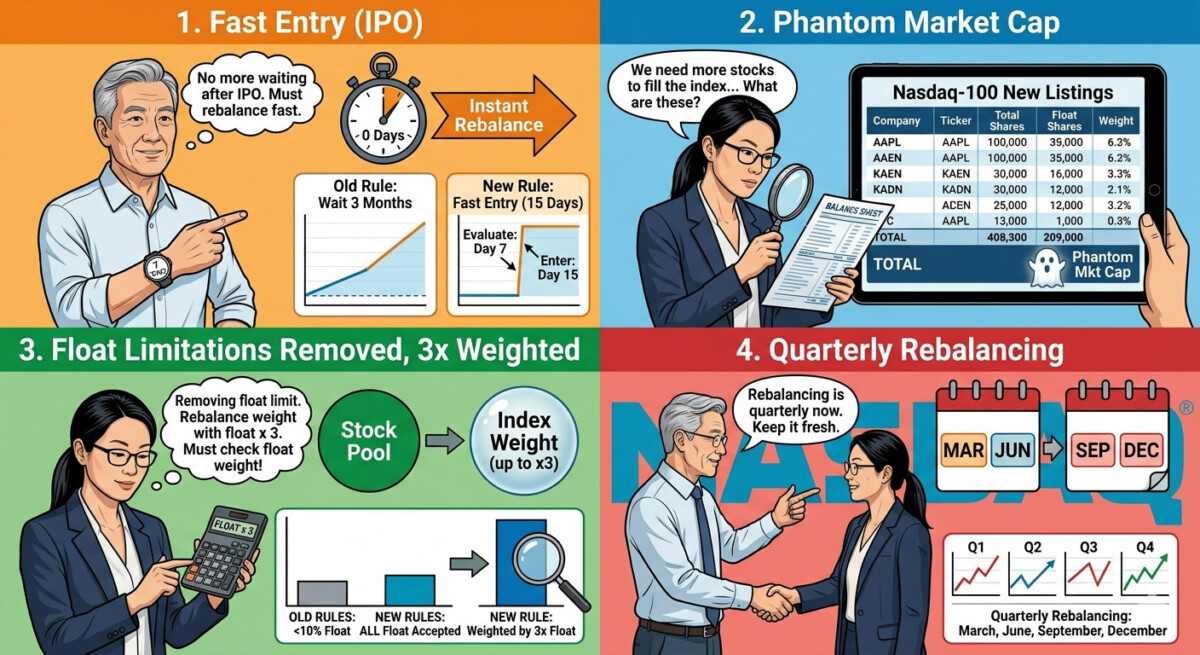
Breaking Down the 4 Major Changes to the Nasdaq 100
The recent amendment boils down to four critical pillars. Together, they radically alter the core behavior and risk profile of the index.
1. The Fast Entry Rule
Under the legacy framework, newly listed companies had to wait anywhere from three months to a full year to be included in the Nasdaq 100. This “seasoning period” allowed the market to properly digest the stock and arrive at a fair price consensus. Under the new regime, the index begins evaluating an IPO stock just 7 trading days after its debut. If it meets the criteria, the stock is fast-tracked into the index in just 15 trading days. Furthermore, the inclusion announcement drops a mere 5 trading days in advance, leaving market participants with minimal time to prepare.
2. Phantom Market Cap Calculation
When ranking companies for index inclusion, the new framework incorporates non-tradable shares, including insider holdings, employee stock options, and unlisted share classes. Media outlets have dubbed this “Phantom Market Cap” because it artificially inflates a company’s size based on shares that cannot even be bought or sold in the open market.
3. Elimination of the 10% Minimum Float Requirement and 3x Weighting Imputation
Historically, companies with a float shares ratio below 10% were strictly barred from entering the Nasdaq 100. This served as a vital safety buffer, preventing mega-caps with low liquidity from experiencing extreme, artificial price spikes when massive passive funds were forced to buy them. This guardrail is now gone; a company with a mere 5% public float can now qualify. To make matters worse, the new rules multiply the actual float by up to three times (capped at 100%) when calculating its index weight. In short, a company with only a 5% actual float will be treated as if it has a 15% float within the index configuration.
4. Transition to Quarterly Rebalancing
The index has shifted from an annual rebalancing schedule (every December) to a quarterly routine (March, June, September, and December). Underperforming components will be aggressively purged every three months. Crucially, the Fast Entry mechanism operates independently of this quarterly schedule, meaning new tech titans can inject volatility into the index at any given moment throughout the year.
Case Study in Risk: SpaceX and the Mega IPO Wave
To understand how these overlapping rules create a perfect storm, let us look at a highly anticipated real-world example: SpaceX.
SpaceX commands a private valuation of roughly $1.75 trillion. Let us assume its initial float shares ratio sits at a conservative 10% upon listing. Under the old rules, only the publicly tradable portion—worth $175 billion—would dictate its weight in the index. Under the new “Phantom Market Cap” rule, however, the index counts the entire $1.75 trillion valuation, including the 90% locked-up insider shares. Consequently, SpaceX will instantly land in the top five slots of the Nasdaq 100 on day one.
The real danger stems from the 3x weighting imputation. A 10% actual float is mathematically scaled up to a 30% weighting factor for index calculations. Trillions of dollars in passive capital tracking QQQ must aggressively buy up shares to match this artificial 30% baseline. Because the actual supply of tradable stock is locked at 10%, a massive wall of passive money will chase a tiny pool of available shares, driving the stock price up into an unsustainable bubble completely divorced from its underlying financials.
Historical precedents of mega IPOs and their post-listing float shares ratio dynamics highlight this exact structural trap:
- Alibaba: Surged 38% on its trading debut to hit $93, but eventually plummeted to $57 (a 39% drop) once insider lockups expired and 1.6 billion shares flooded the market.
- Uber: Slipped 8% on day one and went on to surrender 33% of its IPO value six months later when its lockup expired and released 1.5 billion shares into the wild.
- Facebook: Experienced severe, gut-wrenching volatility, losing up to 50% of its peak value during its early post-IPO and lockup-expiration phases.
In the past, passive investors were shielded from this early-stage chaos by the mandatory seasoning period. Now, passive vehicles like QQQ are legally forced to absorb this extreme volatility, buying up massive blocks of unvetted stock at peak premium prices just 15 days post-IPO.
Who Profits, and Why Retail Investors Bear the Brunt
We must look at this objectively: this framework was designed by the exchanges and index providers, not the everyday investor.
| Beneficiary | Core Advantage |
| IPOs & Insiders (VCs) | Forced buying from passive ETFs guarantees an artificially inflated listing price, allowing early venture capitalists to use retail capital as premium exit liquidity when lockups expire. |
| Exchanges & Index Providers | Attracting mega IPOs becomes significantly easier, and increasing rebalancing frequencies to four times a year drastically maximizes trading and licensing fee revenues. |
| Hedge Funds (Institutions) | Fast institutional players can exploit the predictable 15-day window between an IPO and mandatory ETF inclusion, front-running the index for guaranteed arbitrage profits. |
Conversely, everyday market participants relying heavily on a hands-off dollar cost averaging strategy stand to lose the most. An index is always a zero-sum game fixed at 100%. When unproven, unprofitable companies like SpaceX, OpenAI, or Anthropic enter the top tier of the index with artificially bloated weights, the allocations of proven cash-flow engines like Nvidia, Apple, and Microsoft are automatically diluted.
Essentially, your hard-earned monthly contributions are being weaponized to bail out early-stage insiders at peak valuations. Furthermore, the friction and transaction costs of constant rebalancing will inevitably drive up the expense ratios of these ETFs, eroding your compounding returns over time.
Tactical Adjustments: Navigating the New ETF Landscape
This structural evolution does not mean you should abandon a statistically proven dollar cost averaging strategy. It simply means the era of pure, mindless free-riding is over. To protect your portfolio, you must introduce a layer of calculated asset allocation.
Step 1: Track the Float and Lockup Calendars
Whenever a new mega IPO is announced, make it a habit to audit three vital variables:
- The Real Public Float: Check what percentage of the company is actually tradable to gauge potential supply-demand shocks when the ETF allocation triggers.
- Lockup Expiration Dates: Mark the exact dates (typically 90 or 180 days out) when insider shares hit the market, as these milestones routinely trigger sharp trend reversals.
- The Broader IPO Pipeline: Monitor regulatory filings or financial calendars to track when the next waves of capital-intensive firms like OpenAI or Databricks plan to list.
Step 2: Utilize Sector and Thematic ETFs
If you want to isolate your capital from this structural volatility and stick with proven tech monopolies, you should pivot away from broad indices like the Nasdaq 100. Allocating capital into pure-play semiconductor ETFs, concentrated Magnificent 7 vehicles, or enterprise software ETFs allows you to maintain exposure to high-quality tech without absorbing the forced-inclusion risks of unvetted IPOs. Specialized, highly concentrated products blending elite tech firms with select late-stage giants (such as the upcoming MagP MP models) are entering the market and are well worth exploring as alternatives.
The Nasdaq 100 rule changes will not destroy the market, but they alter the mechanics of passive wealth building. Continuing to invest blindly under an outdated mental model means leaving your capital exposed to institutional exploitation. By staying informed and adjusting your vehicles, you can turn this structural volatility into a distinct competitive advantage.