
The Secret Life of Local Hardware Stores: Why They Never Go Bust After Decades.
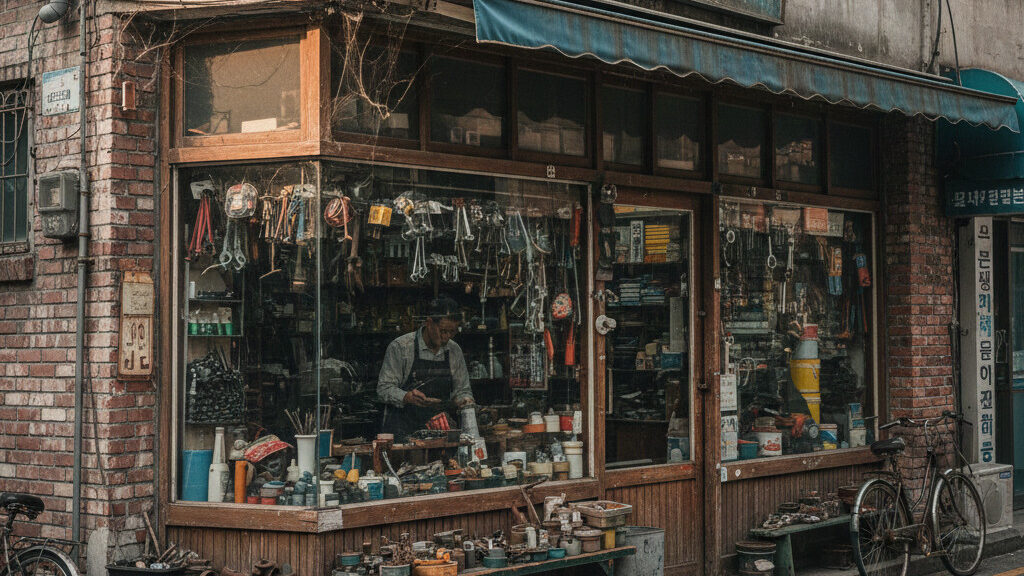
The Secret Life of Local Hardware Stores: Have you ever walked past that old, dusty hardware store on the corner and wondered, “How on earth is this place still in business?” You rarely see more than one or two customers inside. The owner is often seen casually reading a newspaper in the back or isn’t there at all, with a “Back in 10 Minutes” sign hanging on the door.
In an era where trendy cafes open and close within six months and e-commerce giants like Amazon dominate the market, these humble local hardware stores remain unshakable. They are the “immortals” of the local economy. Is it just because they own the building? Not quite. The truth is that local hardware store owners are master economists with a sophisticated business model that even big corporations struggle to replicate.
The Magic of Non-Perishable Inventory
In most retail sectors, inventory is a liability. For a restaurant, ingredients spoil in days. For a clothing boutique, fashion trends shift every season, turning last month’s inventory into “dead stock” that must be sold at a loss.
However, a hardware store deals in timeless assets. A box of galvanized nails or a brass pipe fitting doesn’t rot, expire, or go out of style. If an item doesn’t sell today, it stays on the shelf. If it doesn’t sell for ten years, it’s still perfectly functional. It is the perfect case of non-perishable inventory.
In fact, due to inflation and the rising cost of raw materials, a bolt purchased for 15 cents a decade ago might retail for 50 cents today. Their shelves aren’t just storage; they are savings accounts that earn interest through commodity price increases. This unique characteristic allows them to weather economic downturns that would bankrupt other retailers.
Selling Solutions, Not Just Screws
The biggest misconception about hardware stores is that they are simple retail shops. In reality, they are specialized service providers.
When you see the shop empty, the owner is often out on a service call. Hardware store owners hold a “monopoly on local technical knowledge.” If a pipe bursts at midnight or a circuit breaker trips in an old building, you don’t call an algorithm—you call the person with the truck and the tools.
Consider the profit margin: A faucet might cost $20. If you buy it and leave, the profit is slim. But if the owner comes to your house to install it, the bill becomes $80 or $100. You aren’t just paying for the metal; you are paying for the certainty that the problem will be solved and the risk management that comes with professional expertise. This service-based revenue is highly resistant to online competition because you cannot “download” a physical repair. They are the only owners of local hardware stores but also specialized service providers.
The Hidden Backbone: B2B and Contract Sales

While you might see a few neighbors buying lightbulbs, the real “bread and butter” of a successful hardware store happens behind the scenes through Business-to-Business (B2B) transactions.
Local contractors, plumbers, and interior designers are the true VIPs. For a contractor at a job site, time is more expensive than parts. If they run out of a specific bracket, they won’t wait two days for a cheaper one to arrive from an online warehouse. They go to the local shop where they have a long-standing relationship and a line of credit.
Furthermore, many local hardware stores hold contracts with government offices, schools, and municipal buildings. These institutions require a steady supply of maintenance materials and prefer dealing with local vendors who can provide immediate delivery and simplified invoicing.
Helpful Resources for Entrepreneurs
If you are interested in the economics of small businesses and local markets, you can find valuable data and research through official economic platforms:
The “Knowledge Gap” as a Competitive Edge
In a world of DIY, the “knowledge gap” is a powerful asset. If you go to a massive big-box retailer, the 19-year-old employee in the plumbing aisle might not know the difference between a compression fitting and a flare fitting.
The local hardware store owner, however, can look at a rusted, 40-year-old bolt you brought in and tell you exactly what you need in five seconds. They provide consultative selling. This expert advice builds intense customer loyalty. People return not because the prices are the lowest, but because the advice is the most accurate. This human element creates a “moat” around the business that digital platforms cannot cross.
Operational Efficiency and Low Overhead
Finally, the financial resilience of these stores comes from their incredibly low overhead. Most long-standing hardware stores operate with:
- Family Labor: Reducing the need for a large, expensive payroll.
- Property Ownership: Many owners purchased their buildings decades ago, meaning they aren’t vulnerable to rising commercial rents.
- Minimal Marketing: Their “marketing” is their 30-year presence on the same corner. Everyone in a 5-mile radius knows they are there.
By keeping fixed costs low, they don’t need huge daily sales volumes to remain profitable. They are built for durability, not just growth.
Lessons from the Corner Store
The local hardware store is a masterclass in economic resilience. They teach us that being “un-trendy” can be a strength, that technical skill is a premium product, and that inventory can be a hedge against inflation.
In our fast-paced world, perhaps we should look at these dusty shelves with a bit more respect. They aren’t just surviving; they are thriving by being exactly what the community needs: a reliable, expert-driven anchor in a sea of digital uncertainty.
For more in-depth economic insights and the latest trend analyses, feel free to explore my other articles in the [Journal] menu.