
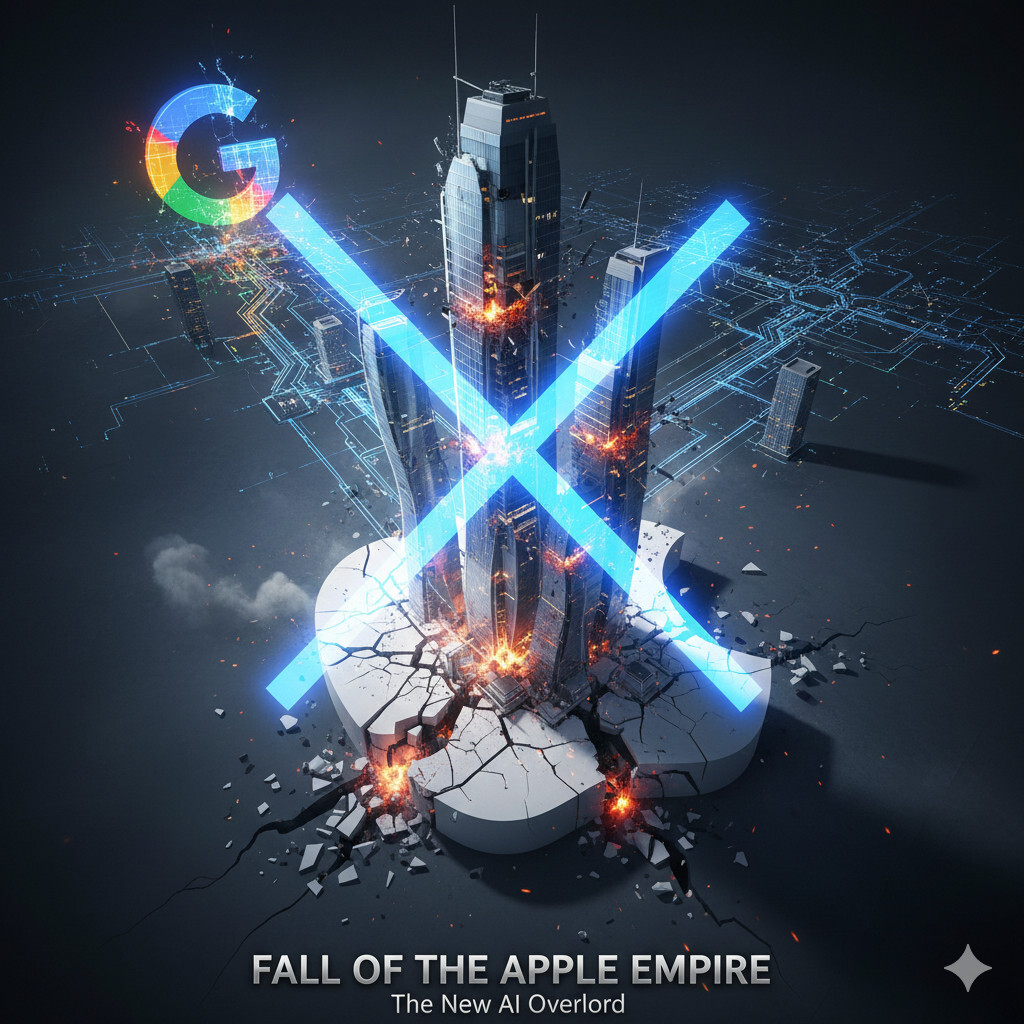
The Declaration of the Google Empire: The Chilling Truth Behind Apple’s Surrender

The tech world was recently shaken by a revelation that many are calling the “fall of the Apple Empire.” Apple, a company known for its fierce independence and “walled garden” philosophy, has reportedly chosen Google’s Gemini to power the AI features in its next-generation iPhones. While mainstream media often portrays this as a simple technical setback or a “humiliation” for Apple, the reality is far more calculated and, frankly, chilling.
This isn’t just a business deal; it is a signal of a massive shift in the global power structure. It is the official declaration of the Google Empire.
Why Apple Chose Profit Over Pride
On the surface, it looks like Apple simply lacked the technical prowess to build its own Generative AI. However, when viewed through the lens of economics, this was a decision driven not by incompetence, but by cost efficiency.
In the world of Artificial Intelligence, the “training cost” (the price to build the model) is just the tip of the iceberg. The real monster is the “inference cost”—the daily expense of processing billions of requests from users. Imagine the infrastructure required to handle Siri requests from over 2 billion active iPhones worldwide.
Apple did the math. They realized that building their own massive data centers would be a financial nightmare compared to leveraging Google’s infrastructure. Google has a secret weapon: the TPU (Tensor Processing Unit). These are custom-designed AI chips that allow Google to run AI processes far more cheaply and efficiently than anyone else. In the classic economic dilemma of “Make or Buy,” Apple chose to buy.
From ‘Intel Inside’ to ‘AI Inside’
To understand the gravity of this partnership, we can look at Ronald Coase’s “Transaction Cost Theory.” Apple found that the cost of internal development exceeded the cost of a market transaction with Google. But this “rational” choice comes with a heavy price: Infrastructure Dependency.
In the past, Google paid Apple billions of dollars to remain the default search engine on Safari. Now, the tables have turned. Apple may soon find itself paying Google—or trading invaluable user data—to access the “brains” of its own devices.
This mirrors the “Intel Inside” strategy of the 1990s. It didn’t matter if you bought a Dell or an HP laptop; the heart of the machine was Intel. Today, Google is positioning itself as the “AI Inside” for the entire world. Whether you hold an iPhone or a Galaxy, the engine under the hood is increasingly likely to be Google’s. This is the ultimate form of Platform Monopoly.
The Unstoppable Vertical Integration of Google

While many people view OpenAI and Google as equal competitors, a look at the “food chain” reveals that Google has built an impregnable fortress. Google’s vertical integration is complete across five critical levels:
- Semiconductors: They own their own chips (TPU), drastically reducing operational costs.
- Infrastructure: They own the undersea cables, the data centers, and the Google Cloud platform.
- Models: They possess one of the world’s most advanced foundation models, Gemini.
- Platforms: They dominate with YouTube, Google Search, Chrome, and Google Maps.
- Operating Systems: They own Android, used by 3 billion people globally.
No other company on Earth—not even Apple—possesses this “full-stack” dominance. Even if OpenAI creates a smarter model, they must still exist within an ecosystem (like Windows or Mac) that they do not own. Google, however, owns the ground, the building, and the air that the AI breathes.
For those interested in the technical evolution of these systems, you can explore more about Infrastructure as a Service (IaaS) to understand how cloud computing powers today’s AI. (Note: This is an external informational link for reference.)
The Lock-in Effect and Cognitive Monopoly
As iOS and Android begin to share the same Gemini foundation, we are witnessing the birth of a global Lock-in Effect. According to the “Scaling Law,” AI models get exponentially smarter as they ingest more data. By powering both major mobile ecosystems, Google will receive an unprecedented loop of feedback and data, allowing Gemini to evolve at a speed no competitor can match.
This isn’t just about market share; it’s about Cognitive Monopoly. When the majority of the world’s population uses the same AI engine to answer questions, write emails, and make decisions, Google’s algorithms become the “standard” for human thought and judgment.
The Intelligence Gap: A New Social Class
The “Utility of Intelligence” suggests that AI will eventually become like electricity—available to everyone at the flick of a switch. On the surface, this looks like the “Democratization of Intelligence.” In the past, only the wealthy could afford personal lawyers or top-tier consultants. Soon, anyone with a smartphone will have a high-level assistant.
However, capitalism is rarely equal. The future may be divided into two tiers:
- The Second-Class Citizens: Those who use “budget AI”—models that are subsidized by ads, filtered by corporate censorship, and trained on public, low-quality data.
- The First-Class Citizens: Those who pay for “Premium Intelligence”—unfiltered, high-speed, private AI that offers a genuine competitive advantage in finance, law, and creative fields.
Just as a millisecond difference in high-frequency trading can result in billions of dollars, the slight gap between “Free AI” and “Premium AI” could create an insurmountable wealth gap in the future.
Adapting to the New Empire
The partnership between Apple and Google is not just a tech headline; it is a textbook example of how capital logic reshapes the world. Google has built the skyscraper, and Apple has moved in as a tenant.
We are the inhabitants of this new digital city. Instead of fearing the change, we must recognize where the power lies. With Google’s massive AI infrastructure now integrated into the iPhone, the possibilities for what we can achieve with a single device are exploding. While the masses complain about monopolies, the wise will look for opportunities within this new “standardized” future. In the age where intelligence flows like water, the one who knows how to turn the tap will find the most success.